Introduction
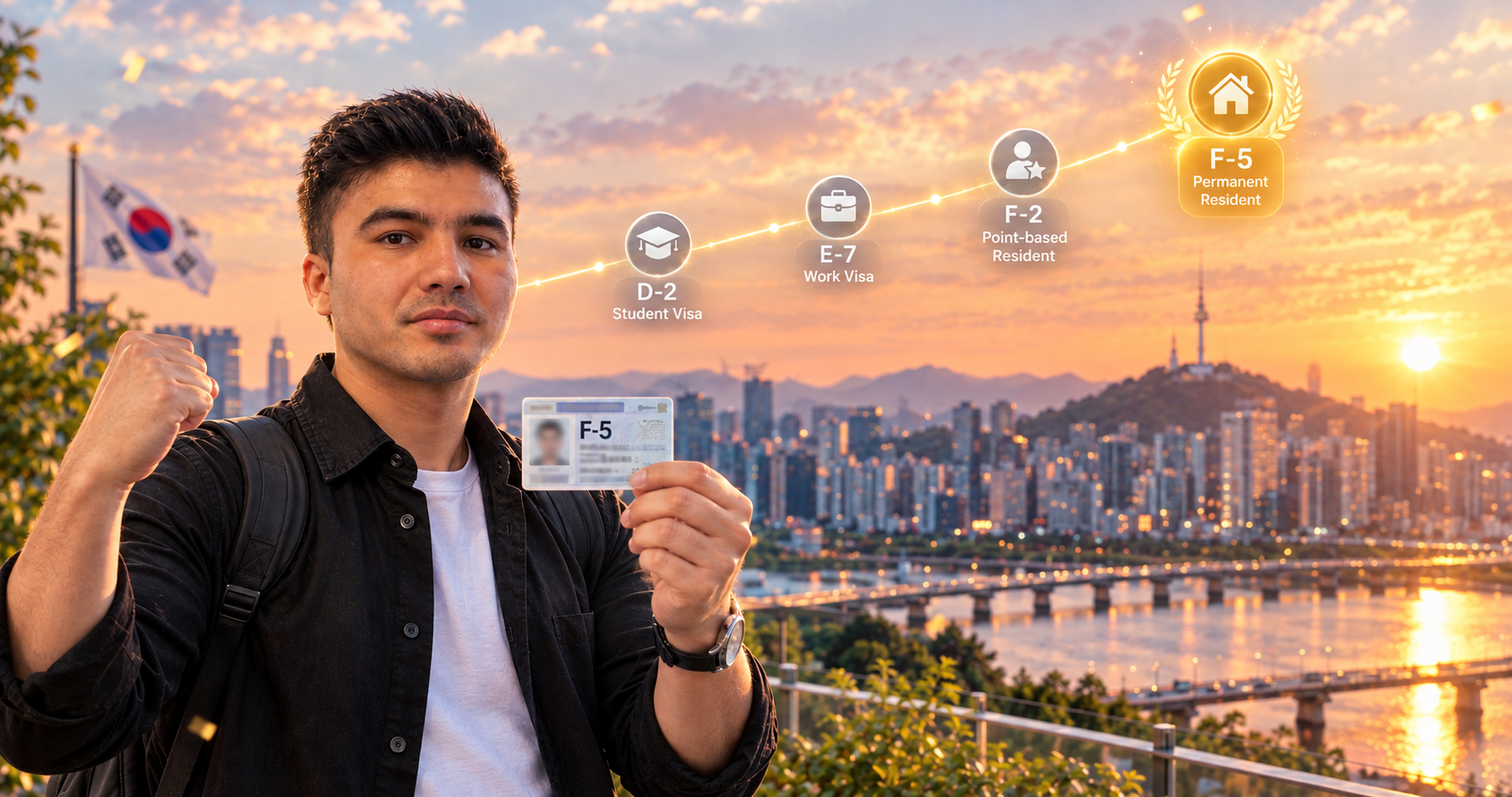
I first came to Korea in 2017, in the fourth year of my bachelor’s degree, on a “3+1 exchange program”. I’ll be honest: on that first visit I did not like the country. A different people, different values, and street after street of restaurants we could not walk into. Then the program ended, I went home, and it slowly dawned on me that going back to Korea was the right decision. In the autumn of 2018 I returned on a D-2-3 visa to study for a master’s. From that day on I spent eight years making trip after trip to the immigration office, and at the end of those eight years I finally got the F-5 visa, the one that grants permanent residency. In this article I have written in detail about every visa I held, the problems I ran into, what went wrong when extending a visa or switching from one to another, and how I solved each of those things. I hope my experience makes for an interesting read and proves useful when you plan your own visa path.
My visa path in brief
| Visa | Period |
|---|---|
| D-2-6 | 2017.06 - 2017.12 |
| D-2-3 | 2018.09 - 2020.08 |
| D-2-4 | 2020.09 - 2024.02 |
| E-7-1 | 2024.03 - 2025.10 |
| F-2-7 | 2025.11 - 2026.05 |
| F-5-15 | 2026.06 - present |
My years on the D-2 visa
Students make up a very large share of the foreigners in Korea, so almost everyone knows this visa type. I would call it the most relaxed and the most troublesome visa at the same time.
- Relaxed: because if you hold it, you are a university student, and until you finish your studies you have the right to live in Korea and to extend your visa. Minor violations are forgiven, or they end with a fine and a warning. On top of that, since you are a student, nobody expects big results from you. In a way, this is the visa that leaves you the most time to work on yourself.
- Troublesome: and that comes from your own needs and means. If you have a sponsor who covers your studies, there is no problem, but if everything is on you, you will often be pushed outside what the law allows and run into trouble. D-2 holders are limited in how they can work and earn money, and that limitation becomes the source of plenty of problems.
I can say I was one of the lucky students. My field is computer engineering, so before coming for my master’s I had already reached an agreement with a professor and joined his lab to work and do research. In exchange for publishing my research results under the lab’s name, I was given a monthly stipend. Not a large one, true: what I earned in a year as a PhD student, an undergraduate could make in two months of peak “season” work. But on the other hand, that arrangement gave me a steady income for 5.5 years and let me put all my attention into research, into widening my professional skills, and into the very thing I had come to Korea for. When I finished and started looking for a job, it turned out none of it had gone to waste. More on that below.
About the immigration raid
In all my time in Korea, taking day jobs was never a habit of mine. During the master’s and PhD years especially, I always had work in the lab and I worked weekends too, so, put simply, I did not even have the time for a side job. But there is a saying: the jug does not break every day, it breaks on its day. And my jug broke on exactly the day I went looking for a little extra income. I walked straight into an immigration raid, spent one night in a detention center and was released with a 1.4 million KRW fine and a warning. The money and the hours I spent in there both faded from memory with time, but it turned into a serious minus on my “profile”. Back then it was clear that if I could not land a job after graduating, I would be going home, because by that point it was obvious my score for the D-10-1 points system would not be enough.
Looking for a job
In the autumn semester of 2023 I got my professor’s “permission” to finish the PhD. Once I had met every requirement and my graduation was certain, I turned my main focus to building a resume and finding work. The platforms I used:
Korean job platforms ask you to fill in your details in full and then generate the CV themselves. Many employers trust exactly that platform-generated CV, which is why it is worth taking your time and making it as complete as you possibly can. How I put my resume together:
- I answered every question the site asked, in full
- I had just graduated, so I had almost no corporate experience; instead I covered my projects thoroughly
- Portfolio: I collected the projects from my studies and my personal interests into a single PPT with demo videos
- Self-Introduction: I recorded a short video introducing myself, so that my application would stand out in a long list of candidates
Preparation took me more than two weeks. On the Monday of the following week I started sending my CV out to companies and switched on the “Open To Work” badge on LinkedIn. Here is how the search went, as a timeline. Company names are shortened to A, B and so on.
| Date | Company | Note |
|---|---|---|
| 2024.01.15 | 10 or more | Started sending my resume out through Saramin |
| 2024.01.16 | A | The first interview invitation came very fast |
| 2024.01.16 | B | At the same time an HR manager reached out on LinkedIn and said they had a position that suited me |
| 2024.01.17 | A | Went to the interview and somehow got through it in Korean. The interviewer did not even know “hello” in English |
| 2024.01.17 | C, D | Two more companies invited me to interview the same day |
| 2024.01.17 | A | Towards the evening I was invited to a second interview, this time with partners from LG |
| 2024.01.18 | B | First interview for the position offered on LinkedIn. It went in a very positive mood |
| 2024.01.18 | B | After the interview HR called and said the second round would be with the CEO |
| 2024.01.19 | A | Second interview with the first company, over Zoom. Again I could not speak English |
| ~ | ~ | Weekend |
| 2024.01.22 | A | After two interviews I was rejected for not knowing Korean |
| 2024.01.23 | B | This interview was with the CEO; we mostly talked about the company’s future and what we could build together |
| 2024.01.23 | B | After the talk with the CEO I got a job offer before I had even left the building, and accepted it on the spot |
| 2024.01.23 | C, D | Since I already had a job offer, I cancelled the interviews scheduled for that week |
| 2024.01.25 | C | They said they were sorry I had cancelled, but that the CEO wanted to meet me, and invited me to a coffee shop |
| 2024.01.29 | C | We met. They said they still wanted to hire me and could pay more than I had been promised elsewhere. I apologised and said I had given my word and could not walk away from it now. I never worked at that company, but I was glad of the trust they put in me |
| 2024.02.16 | B | Received my diploma and applied for the E-7 visa with the company’s documents |
| 2024.03.06 | B | My E-7 visa application was approved |
| 2024.03.07 | B | Started work as a Senior Engineer |
So, counting working days, I had a job within six days of sending out my first application. The funny part is that I never applied to the company that hired me. They never saw the portfolio or the videos I had prepared. It happened simply because LinkedIn’s algorithm put my profile on an HR manager’s screen. But it would be wrong to say the preparation went to waste. During the interview, when they asked me about myself, I said I would present my portfolio instead, and after that there were no further questions about me or my experience. In short, the interview was not a question-and-answer session but more of a presenter-and-listener one, and in some way that worked for the company.
In my first months in the new job I often wondered whether I should have taken company C’s offer and the higher salary. But years later, I understand that I made the right call, for two reasons:
- A year on, I could not find a trace of the company that offered more. No website, no news. My conclusion is that it closed not long after.
- I have now been with one company for more than two and a half years, and in that time I obtained the E-7, the F-2 and later the F-5, with the company backing me on every single matter.
Another thing worth noting: I was hired at Senior level even though I had no corporate experience. That was down to what I achieved during the PhD and the projects I took part in. So if you have finished a master’s and are weighing whether to do a PhD, I would definitely tell you to do it. You do not lose three or four years; those years are written down as experience. And once you have the PhD, you are no longer starting from zero.
F-2-7
Moving to the F-2 visa is usually seen as a major milestone, because this visa:
- frees you from being tied to a company or a school
- gives you the right to open a business in your own name
- makes it easier to bring your family over
- and many other advantages… Put simply, this visa is exactly what its name says, “point-based residence”: as long as you can collect enough points, you count as a resident of Korea.
In my own experience, though, it was never a dream or a finish line; for me the F-2 sat at the same level as the E-7. Why? The reason is simple. With the F-2 you are not obliged to stay at one particular company, but to collect enough points under the system you still have to be working somewhere. Which means that if you relax once the F-2 is in hand, you will regret it when the time comes to extend it. So for me there is no difference between an E-7 tied to a company and an F-2 that is independent of one. The reason I got the F-2 is simply that my score was enough, and legally it sits well above my previous visa, so why would I not take it?
An unexpected problem and an unexpected solution
By my own count my total was 95 points. The minimum for the F-2-7 is 80. I was relaxed about it, but just in case I had also filled in an application to extend my E-7. If the F-2 was refused, I was ready to hand the same documents in to renew the E-7.
And then the unexpected happened. The officer looked over the points sheet I had calculated myself, recounted every item one by one, and at the end wrote down -20 points… It hit me at once: of course, I had that 1.4 million fine. So my score now stood at 75, and that is not enough for the F-2. I started getting the E-7 documents ready. But the officer was not finished. They looked through a couple more documents, went back to the points and wrote +15. That surprised me.
I understood later: the university I graduated had just been added to the newly updated list of “top 1%” universities. Which makes me a graduate of one of Korea’s top 1% universities, and that is worth +15 points.
So the total came to 90, and I was given the F-2 visa for two years. It did not last two years, though. Before even the first year was out, I had managed to switch to the F-5.
F-5-15
There are close to 30 subtypes of the F-5 visa, each with its own requirements. Unlike the F-2-7, the F-5 subtypes do not follow a points system; they simply assess whether you fit the one subtype you have chosen. Processing time differs by subtype as well: for one person it can be under a month, for another close to a year. Here we are talking about the F-5-15 subtype, and these requirements apply to that subtype only.
F-5-15 : the residency visa for people who earned a PhD from a Korean university. Compared with the other subtypes, this one comes with a number of concessions out of respect for the PhD. Among them:
- the annual income requirement is lowered from GNI x2 to GNI x1. If you hold a KIIP level you can bring it down further, to 70%, but I have no Korean language certification.
- the requirement to know Korean is dropped
- the requirements on minimum employment are dropped
- and others
I started preparing well in advance, because meeting the GNI requirement means filing a tax report for the last completed year. The notion of the last completed year matters a great deal here, and it changes depending on the date you file. The general rules:
- every March the figure for the previous calendar year is officially announced, and it takes effect from 1 April
- which means that until the last day of March each year, the GNI announced for the year before that is the one that counts Imagine the GNI figure for 2024 was about 50 million KRW, and for 2025 it was 52.6 million. If you filed on 31 March 2026, it was enough to prove that your income for the past year was above 50 million; but if you file on 1 April, you now have to show more than 52.6 million. At the same time, the document from the tax office that proves your income is usually ready only in May. So if you are filing on 31 March 2026, all you can prove is your income for 2024; the report for 2025 is not ready yet. At least that is how it works for people on a company payroll. There are other ways of proving income.
How I met the GNI requirement
In my case my 2024 income was not enough, because I started work in March; two months short meant the total did not reach the GNI figure. So I had no choice but to wait for the 2025 report. The bad part was that until March 2026 came around, I had no way of knowing what GNI figure would be announced for 2025. The only thing in my hands was to make my income noticeably higher than the 2024 GNI figure, as that was the only way to reach the goal without gambling.
Even though my contractual annual income was already above the current GNI figure, I started working on it at the very beginning of autumn so as to leave nothing to chance. I explained the situation to the people responsible at work and asked them either to raise my salary right away or to give me an extra bonus for 2025. They took it very well, said they were ready to help, and said that since it was not the season for salary negotiations, the bonus option suited them better. And so the GNI question was settled very easily.
Filing the documents and the review process
I got the list of documents by calling 1345. I rewrote the long list in a form I could understand, numbered it, and started preparing. It took quite a while, but step by step I got everything together. After checking it over and over, the appointed day finally arrived and I handed in my documents.
The officer greeted me warmly and in a good mood. After all, it is not every day that an F-5 applicant walks in. There were a few things missing (and they were not on the list I had been given). But my application was not refused over them. My documents were accepted and I was asked to bring the extra papers as soon as I could. I prepared them that same day and was back within two hours; the officer recognised me straight away and added them to my file. I had deliberately taken time off work, after all, so every minute counted. Once you work at a company you turn into the kind of person who tries to get paperwork done without wasting even an hour.
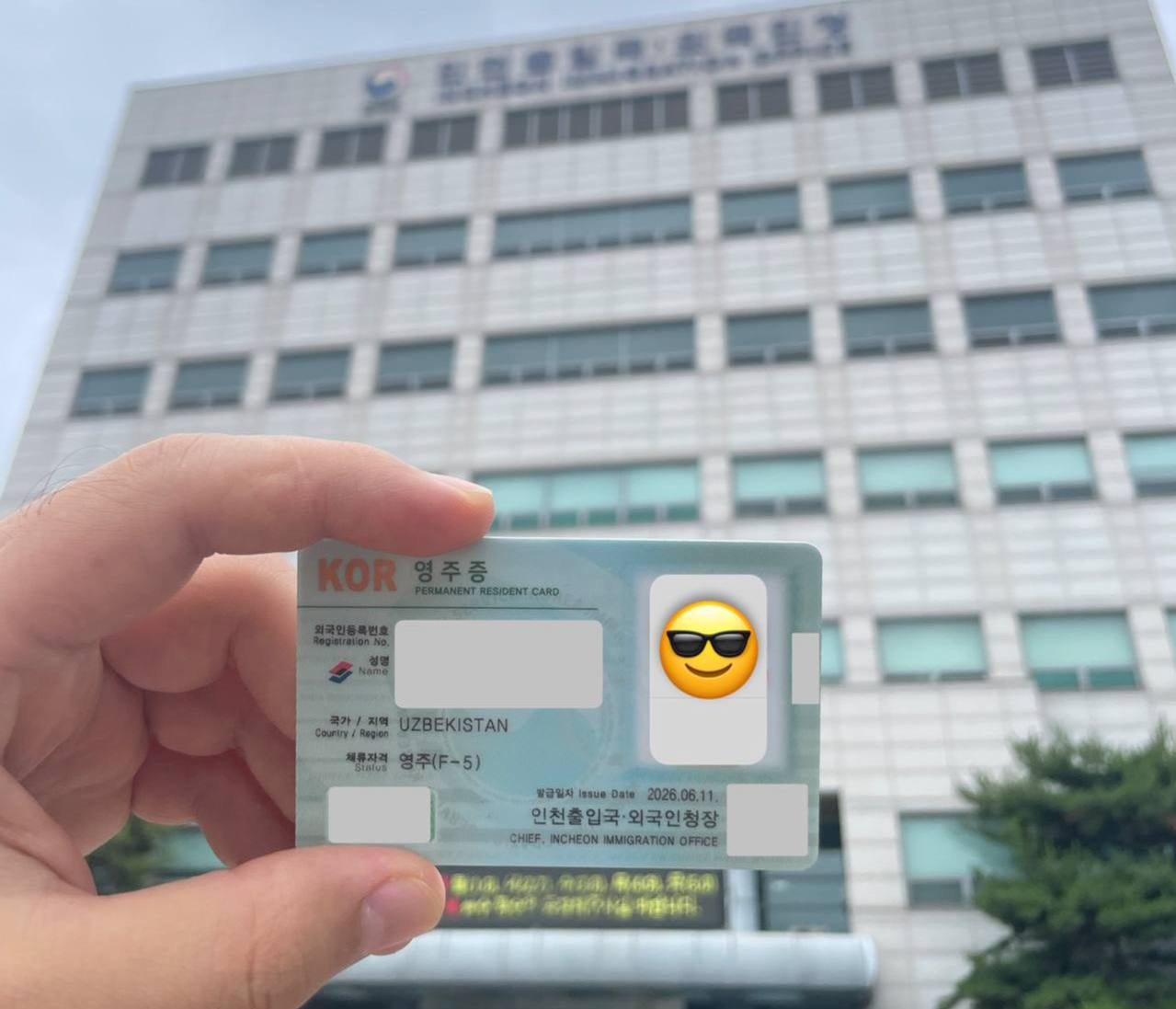
I came home in a good mood, and then noticed an SMS from 1345. It said that the fine I had paid during my D-2 years had been identified, and that for my F-5 application to be accepted I would have to complete a special course (준법시민교육). I called 1345 again, explained the situation and got answers to all my questions about what the course was and how to register for it. It turned out to be a three-hour seminar organised by immigration: you simply attend, and you are given a certificate with no exam. I booked the nearest date available, attended the seminar and handed the certificate in the same day. This time it was a different officer, not the one who had taken my documents. I explained the situation to them as well and they accepted it. Less than a week later, on 15 June, I checked my visa status and there it was: F-5 (9999-99-99). It had been approved on 11 June, the very day after I submitted the extra documents.
When I asked on the day I filed, the officer told me plainly that review takes between six months and a year, which is why I had been expecting the autumn at the earliest. I do not know the exact reason the decision came so fast, but I have my guesses. Maybe submitting the extra documents reopened my file and sped up the decision. Maybe, because it was the F-5-15 subtype, they thought this guy already waited 5.5 years for the PhD and did not want to keep him waiting any longer. Or maybe the F-5 review requirements have simply been eased and applications are being approved faster. I later learned that I am not the only one who got the F-5 within a month; cases like this have become a lot more common lately. Going by that, my last guess is probably closest to the truth.
The documents I submitted
General documents for the F-5 visa
- 통합신청서(별지 34호)
- 여권
- 외국인등록증
- 수수료(20만원 + 등록증 3만5천원)
- 표준규격 사진 1매(3.5X4.5)
- 영주(F-5)자격 신청자 기본정보 (신청외국인 작성자료)
- 체류지 입증서류
- 신원보증서(별지 129호)
- 신원보증인 신분증 사본 -> a copy of the ID of the person who signed the 신원보증서
- 품행단정 요건 입증서류 : 해외범죄경력증명서 제출 면제 -> the criminal record certificate is not asked for again, since I submitted it when I got the F-2-7
- 생계유지 요건 입증서류 : 소득주체별 제출
- 납세증명서
- 지방세 납세증명선
- 체납증명서
- 소득금액증명서
Documents specific to the F-5-15 visa
- 박사 학위증 사본 (학위증 원본 및 성적증명서) -> PhD diploma and transcript
- 소속기업 사업자등록증 사본
- 재직증명서
- 4대 보험 사업장 가입자 명부
- 고용계약서 등 정규직 여부 확인 서류 등
Advice
Learn the language
This may read a little oddly. After all, I still do not know Korean myself. But my case only fits one particular group of people; it cannot be taken as general advice. Speaking for myself: I have lived in Korea for over eight years and have still never felt a strong need to learn the language. There have always been people around me who could speak English with me, and what was asked of me was not speaking but doing my job properly. That was reason enough for me to be lazy about the language, and I never used my student years to learn it. On the visa side it did not become a problem, but in everyday life the need is always there, and it trips me up almost daily. As long as you live in Korea, learn the language. Being able to talk to people in their own language is the first step to finding your way to their hearts.
Set a specific goal
Whether it is the F-5 or the F-2, know in advance exactly which subtype you need. Simply aiming to get the F-5 is not enough. You need to know precisely which F-5 subtype you are going for. In my own case, when I began the PhD in 2020 I studied every F-2 and F-5 subtype and planned back then what I have achieved today. Even so, I ended up a year behind my own plan. With a more thorough plan I would have had the F-5 sooner. My point is that the visa question is not something you start thinking about a month before your current one expires; plan it far ahead and you will reach the goal far more easily.
Focus on your profession
The first step to avoiding visa problems is being able to prove that Korea needs you. Let me put it bluntly. Korea can always find factory hands or postal workers; it does not have to be you. But master a profession so thoroughly that your absence would be felt. Then demand for you is high, and people will turn up who will sort out any paperwork problem you have. I am not saying you have to be a developer or an engineer. Be a translator, be a teacher, an analyst, an economist, a doctor, a lawyer, a trader, whoever you are, just be one of the best in your field. That is the real achievement. All the visas come as a bonus.
Final words
First of all, thank you for reading this article. If there was anything in it that can help you, then we have achieved what we set out to do. And if you too are running into problems on the way to the F-5, do not give up! Little by little everything gets solved, and you will reach your goal. When I first came to Korea and read about the F-5 visa, I thought that when the time came I would have to spend two or three years on learning the language. And once, sitting in an immigration detention center, I even gave up the dream of getting the F-5 altogether. But none of it stood in my way; in the end it all resolved very easily. I am not saying you should get a PhD as well. There are close to 30 F-5 subtypes, and one of them will certainly fit you. Just spend a little time studying them properly, and do not stop moving towards that goal. Good luck!
Comments
Comments come from our Telegram channel. Sign in with Telegram to join the discussion.
Open the discussion in Telegram