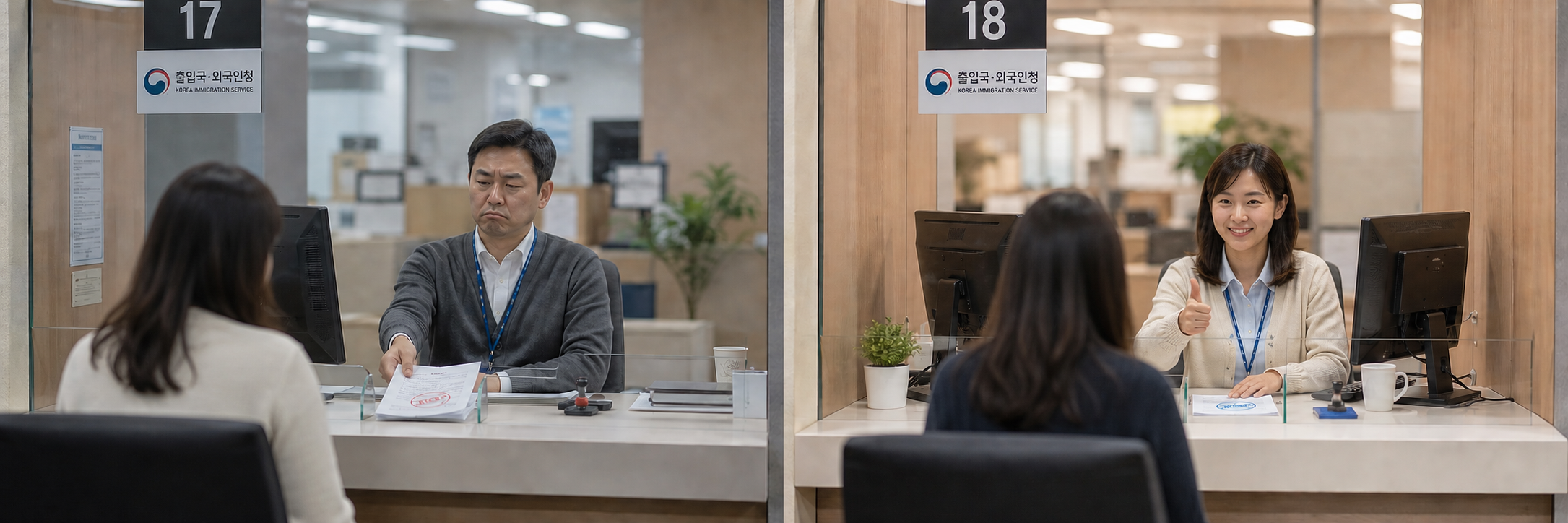
Introduction
Does an officer’s mood affect the outcome of your application? Yes and no.
- No -> Immigration officers are all professionals with genuinely deep knowledge. They will not reject documents you have prepared properly just because they are tired or out of sorts.
- Yes -> If you do not prepare your documents thoroughly and leave everything to the officer’s discretion, then it certainly has an effect.
There were less than 30 minutes left before closing time. You could see at a glance that the officer was worn out from a day spent on very troublesome paperwork. While waiting my turn I had watched the last three applicants take a very long time and go back and forth filling in missing documents. Perhaps that is why our conversation did not start well and my requests were turned down, and yet we said goodbye in a very good mood. That day I was glad to have had a positive effect on the officer’s mood, and I took an important lesson away for myself. In this article I will tell that story in detail. I hope this slice of real experience helps others when they prepare their own visa documents.
This is not about one particular visa type, but about a document preparation process and its outcome, as actually lived through. Whatever application you walk in with, you will go through roughly the same preparation, and this experience fits every case equally. That is why I have tried to cover the process down to the smallest details.
What happened
I needed a new visa for my family – a residency one. Simply renewing an old visa is very easy and can be done online. But switching to a new visa type, and applying for a resident visa in particular, is another matter: it calls for flawless preparation and goes through close scrutiny. So this is not something to gamble on, handing in documents on the thought that “maybe they will not ask”. As always, I started by calling 1345 and asking for the list of documents required in my case.
Preparing the documents
When I spoke to 1345, the officer did not sugarcoat it and told me the situation straight: “the visa you are asking about is quite hard to switch to. The documents are not easy to prepare.” They turned out to be right. I had never put together that many documents before. I even had to cancel the appointment I had already booked and move it further out. But there was no way back, only forward. First of all, I started by grouping the documents:
- Documents to be brought from Uzbekistan
- Documents to be collected in person inside Korea
- Documents that can be issued online
- Documents to be filled in by hand
Preparation began, in that order.
- First I prepared the documents from Uzbekistan. The fact that government services there have been moved online made my job a good deal easier. I downloaded every document I needed from the MyGov portal and had the apostille done. Pay attention. Not a plain translation: we are talking about the apostille. I have already been taught this lesson once. All my documents were in order, and only because the “apostille” stamp was missing from one single translation, I had to prepare everything over again. So my advice is to always get the apostille wherever a translation is asked for.
- In Korea too, almost every document can be obtained online; the medical certificates were the only exception. The first problem was finding a hospital that issues the certificate we needed, because the requirements called for a report covering tests for every disease and virus on the list. When I called the 보건소 (public health center), the answer was, “we do not do those tests here.” I contacted the 병원 (hospitals) one by one. One said, “we have all of them, but we only test women.” Another said, “we have every test except one.” Searching on like that, I finally found it at a large university hospital. That part alone took close to three weeks (searching, booking an appointment, taking the tests and waiting for the results). Shortcut. If you need a medical report, do not think twice: contact the largest 병원 near you. The prices for medical checks turn out to be almost the same everywhere, so going straight to the biggest one saves you time.
- Then came the documents to be filled in by hand. These were not easy either: there were questions covering everything from personal details to our entire family history. I filled it all in without rushing.
- Finally, the documents issued online were obtained closer to the date of the immigration appointment.
- Even though our documents were ready, past experience led me to add the ones there was a chance they might ask for as well. Among them were extra details about the company, documents on insurance and tax payments, and a year’s worth of bank transactions proving that my salary lands in my bank account every month.
Handing in the documents
The appointment had been booked for after 4 pm. I arrived half an hour before the scheduled time, because there are things to get done before your number comes up.
- First we had our photos taken there
- The fees were paid in advance
- The photos were glued onto the application forms
- Every document was checked for signatures, and the dates were confirmed once more as matching With that, everything was ready. All that was left was to wait for our number to be called.
And then came a pang of regret. Why? — because I had booked an evening slot. Normally 12 minutes are allotted per applicant, but a case is not always settled inside 12 minutes. For some it takes less, for others more. That particular day happened to be a day that took more for everybody. We ended up waiting more than an hour past our booked time, and our first turn arrived after 17:30.
Lifehack. Try to book your immigration appointment for the morning, especially if you have a lot planned for the day. In the evening your turn can come earlier than scheduled or hours later, and there is no way to know in advance. Only the morning slots are called on time. And on top of that, officers are in a better mood at the start of a fresh day.
While waiting for our turn, I had seen the very officer who went on to call my number take three extremely troublesome applicants. How did I know they were troublesome? That was not hard. All three were one group, and as far as I understood they had all come with the same situation. One of them kept coming back in place of another to make up missing documents, so it was easy enough to tell that this was a troublesome case and that it was spoiling the officer’s mood. Spending close to an hour on just three applicants says enough about how troublesome it was.
I had in fact come with two applications, and I asked the officer whether the two “call numbers” were the same and whether both could be taken at once. Having only just come through a similar “case”, the officer answered rather curtly, a flat “no, one applicant per number.” Let me say here that booking the two numbers 20 minutes apart paid off. Imagine that while I was sitting there with one application, another officer called the second number. How would I have turned up in two places at once?
I handed in the documents and sat waiting quietly; you could see the officer was worn out from the whole day. Even so, it did not take long. They went through every document one by one and within about five minutes handed me the acceptance receipt and told me I could go. Glad that our first case had gone through, I waited for the second number, and that did not take long either. And what luck: the second number came up with that very same officer.
I walked up quietly and said, “I am back.” Since I had mentioned a little earlier that I had two applications, they grasped the situation at once and took it in, surprised themselves that I had landed with them again. This time their mood was a little better. I handed over the documents and settled in to wait again. This time, too, it did not take long. After a short wait, they handed me a second acceptance receipt. And the interesting part began right after that.
Out of nowhere, the officer paid me a compliment: “엄청 완벽해요. 오늘 처음이에요” (meaning “you prepared this really well, this is the first application like it I have had today”), and gave me a 👍 thumbs up. I said thank you, and when I looked at the officer I saw a completely different person. In place of the tired, out-of-sorts officer I had greeted on arriving, there now stood a friendly one, full of energy and in a good mood. That day I did not just get my own matter settled, I had also been the reason someone’s day got better. I did not win them over with sweet words, nor lift their mood with a gift. I simply prepared my documents thoroughly, left them with no questions at all, and made their work easier. Instead of spending three or four minutes explaining why a document cannot be accepted in that form, they could now have a hot cup of tea and catch their breath.
The lesson
Whenever I think back on this, what the officer said is always what makes me wonder: “오늘 처음이에요” – “the first one today”…
It was getting on for six o’clock, and after me they would take another two or three applications and close out the working day. Could it really be that not one fully prepared application had come in from morning to evening? Of course they had; but they were complete as seen from the applicant’s side, not through the officer’s eyes. How does that work? As applicants we prepare all the required documents, and we leave the things that can be done at the immigration office open, thinking “I will do it if they ask.” That includes paying the fee, having a photo taken, or gluing the photo on and signing the form. If your documents are complete, the officer naturally tells you to go and pay, then waits, or works with the next applicant. When you come back, they have to open your file and confirm it all over again. These things may look trivial, a minute or two each, but imagine: two extra minutes for thirty people a day adds up to an hour. So what is trivial for us becomes hours lost out of every single day for the officer.
Advice
Always Overdo. For me this is a standing rule when dealing with visa documents. Take a birth certificate: a plain translation will usually be accepted, but for me overdoing it means getting the apostille. Maybe the translation would pass, but what if it does not? One single doubt can cost me another two weeks of running around. Or take insurance documents and bank transactions: they are not always requested. But what if they are? For a document I could simply have printed online, I might have to make the trip to the immigration office all over again. That is why I always prefer to turn up with more preparation than is needed and more than is asked for, and that is what I recommend to everyone.
Mind the small details. Make sure every document is dated, that the photo really is glued on where one is needed, that the fees are paid in advance, and so on with every detail that looks trivial. Because these invisible little problems are exactly what officers run into over and over, with every applicant, every day. You go there once a year, but the officers talk to hundreds of applicants like you every day. It is no surprise at all when small problems turn into big ones. Here is one more detail as an example. I always pay attention to the order of the documents too. By leaving the officer no need even to rearrange the pages, you show just how thoroughly you have prepared.
Arrive early. Plan ahead for the day you go to immigration and arrive at least half an hour before your appointment time. For a start, the queues for paying fees or having photos taken can be long. Arriving early means you get through all of it without rushing. Beyond that, the extra time lets you check your documents over yourself beforehand. Maybe there is a spot you forgot to sign, maybe a question you left blank. That time matters precisely so you can fill in those small details and bring your documents to an ideal state.
Comments
Comments come from our Telegram channel. Sign in with Telegram to join the discussion.
Open the discussion in Telegram